
A recycled label answers one question: where some of a garment's material came from. It does not, by itself, say whether that garment can be recycled again, whether discarded clothes supplied the fiber, or whether the material is available at the volume a collection needs.
That distinction is becoming more useful than the label itself. Recent textile research, runway applications and purchasing agreements show progress on three different fronts: supply, design and demand. Treating them as interchangeable makes the technology harder to evaluate.
More recycled polyester does not mean more recycled clothing.
A September 2026 benchmark covering 384 participating brands and retailers, including subsidiaries, reported that recycled polyester rose from 67% to 76% of their polyester use between 2024 and 2025. Yet textile-to-textile feedstocks across cotton, polyester, nylon, viscose and wool remained at 2% of the cohort's total raw-material usage. The reporting companies are not a representative sample of the whole industry. [1]
The figures measure different things: one is recycled content within polyester; the other is textile-derived material across a broader set of inputs. They cannot be subtracted to calculate a recycling shortfall. They do show why a sourcing brief needs to identify the feedstock, not just request a high recycled percentage.
Waste is not the same as usable fiber.
An October 2026 model estimates about 10 million tonnes of recyclable textile feedstocks in 2025, but only 1-1.5 million tonnes of available recycled spinnable fiber. For 2030, the corresponding projections are around 15 million tonnes and 3-5 million tonnes. These are directional estimates for apparel and home textiles, not measured factory output or guaranteed supply. Plastic bottles and technical textiles are outside the study's scope. [2]
Collection, sorting, composition, processing and technology compatibility intervene between a discarded garment and new yarn. The model combines reported information with proxies and assumptions; it is not a census of every recycling facility. Its central lesson is practical: a large waste stream does not automatically create a large pool of usable material.
The design possibilities are getting more interesting.
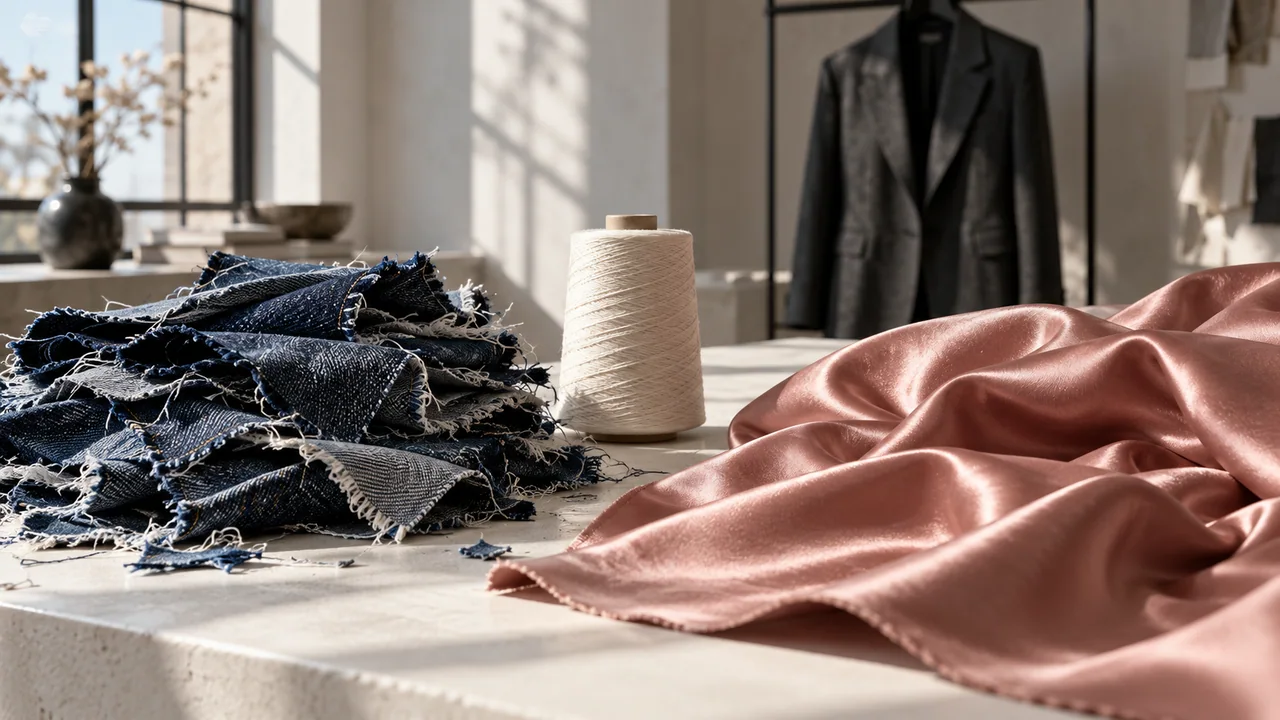
At Florentina Leitner's October 5 Paris Fashion Week show, Circ reported denim pieces containing 40% textile-to-textile recycled content and pink satin pieces containing 30%. The denim combined cotton and Circ Lyocell; the satin combined viscose and Circ Lyocell. These are supplier-reported compositions for the featured pieces, not a claim that the entire collection was made from recycled textiles. [3]
The useful creative signal is variety. Textile-derived material is being explored in both structured denim and fluid satin, rather than being confined to a single visual language. A runway application demonstrates a design use; it does not establish universal durability, price parity or environmental superiority.
A purchasing commitment is not today's inventory.
Circ's September 28 announcement with Primark describes a multi-year agreement intended to bring textile-derived recycled polyester into clothing in 2029. The announced material would come from Circ's commercial facility. This is evidence of a future purchasing commitment, not proof that those volumes are already being delivered. [4]
Runway adoption and longer-term purchasing agreements answer different questions. One helps establish what designers can make. The other can support plans to produce more material. Neither removes the need to confirm an actual supplier's quantities, specifications and delivery dates.
Four questions make a better material brief.
- What is the input? Specify textile-derived or bottle-derived feedstock, and distinguish manufacturing waste from used garments.
- What is the percentage? Request the share in the finished fabric or garment, not only in one ingredient or a supplier's portfolio.
- What can be delivered? Separate a sample, an announced plant and a confirmed commercial order. Record volume, lead time, composition tolerances and repeat-order availability.
- What happens after wear? Ask whether an identified recycler can accept the finished construction, including blends and trims. Recycled input is not an end-of-life plan.
Those questions are an editorial sourcing framework, not a score assigned to the companies discussed here. They lead to a clearer decision: select a fabric for its design and tested performance, then substantiate its material story at the product level.
The next step is specificity. Recycled content, recyclability and reliable supply are three separate claims. Fashion's new materials become more useful when all three are evaluated separately, rather than compressed into one reassuring word.
References
Sources reviewed October 17, 2026. Benchmark data describe participating companies; supply figures are modeled estimates; product compositions and delivery plans are attributed to the supplier.
- Textile Exchange: Materials Benchmark Insights and Trends 20262026-09-22
- Textile Exchange, Fashion for Good, Reverse Resources and TEXroad: Textile-to-Textile Recycled Fiber: Availability Data for Apparel and Home Textiles2026-10-06
- Circ: Circ Returns to Paris Fashion Week with Florentina Leitner, Debuting Circ Lyocell in Denim and Satin2026-10-05
- Circ: Circ and Primark Announce Long-Term Partnership to Scale the Use of Textile-to-Textile Recycled Fibres2026-09-28