
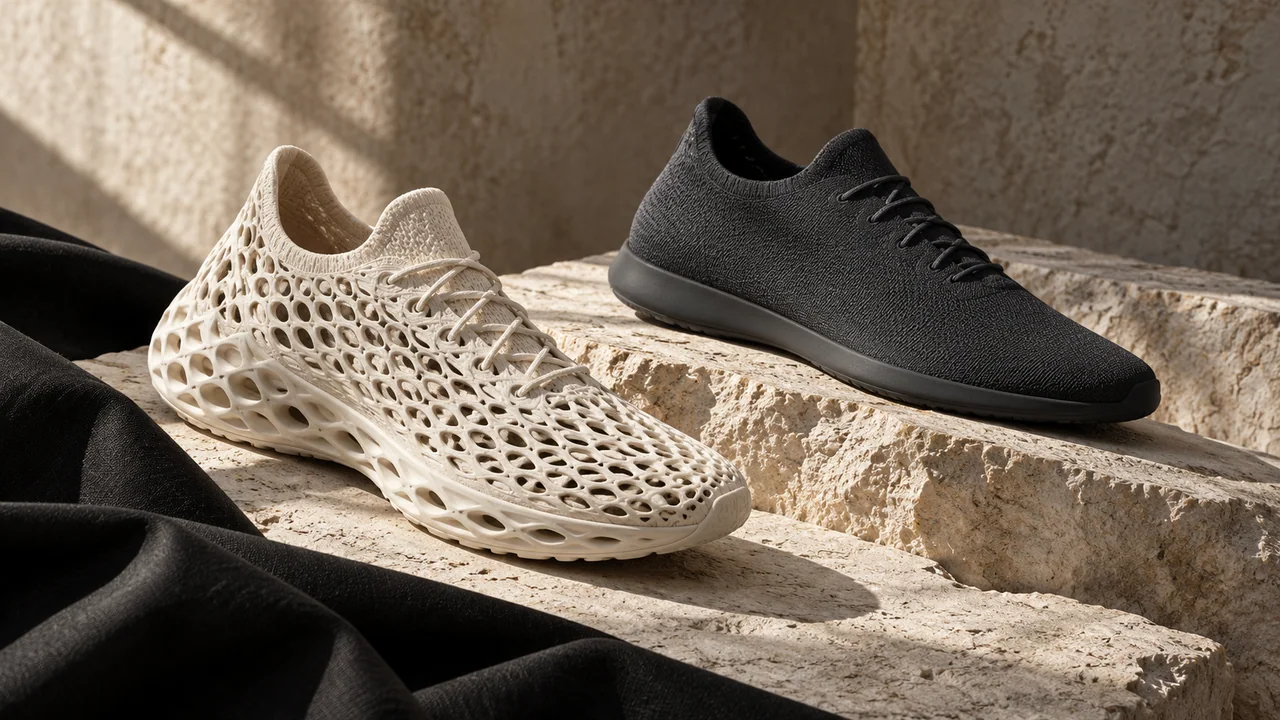
The next wave of sneakers is changing more than the silhouette. It is changing how the silhouette gets made. But a sprayed upper and a printed shoe are not the same innovation, and neither manufacturing label is a shortcut to judging the finished product.
Recent announcements from On and adidas reveal two different design opportunities: simplifying the upper around the foot, and turning the shoe itself into a sculpted structure. The distinction matters for collection planning, product storytelling and the expectations set before a customer tries a pair on.
One changes the upper. The other changes the structure.
On's LightSpray uses a robotic arm to apply filament around a shoe last. The company describes an approximately three-minute process for producing a one-piece upper. In February 2026 it announced a second production facility near Busan, with 32 robots, and an intended thirtyfold increase in global LightSpray production capacity during 2026. That is a capacity statement, not a published count of pairs manufactured or sold. [1]
The same announcement connected the facility to the LightSpray Cloudmonster 3 Hyper and a move from racing into run training. The interesting fashion signal is a manufacturing technique expanding into another product use, not evidence that every sneaker category will adopt it. [1]
adidas presents a different proposition with Futurecool. Its August 2026 announcement describes a resin-based, single-structure 3D-printed shoe with sculpted proportions. The brand explicitly positions it as a lifestyle silhouette rather than a performance running shoe. Comparing it with a race-oriented upper as if the two were substitute technologies would miss their different purposes. [2]
The launch calendar is part of the design story.
Futurecool's first-access announcement covered 400 individually numbered pairs, with a wider launch scheduled for April 1, 2027. As of this article's publication, that wider release remains a future plan. A limited introduction can establish a new visual language without establishing broad retail availability. [2]
There is also a less speculative reference point. adidas announced wider availability of CLIMACOOL LACED on March 3, 2026, following an earlier limited introduction of the 3D-printed sneaker. Its lattice construction and added laces show that a new manufacturing platform can still evolve through familiar styling and fit choices. That release notice establishes the brand's rollout announcement, not current stock in every size or market. [3]
Keep the benefit as specific as the invention.
A cleaner form is easy to see. Comfort, durability and environmental impact need a different kind of evidence. The releases describe manufacturer benefits; they do not supply a common independent wear-test protocol that ranks the shoes against one another.
Even a quantified claim needs its boundary. On's original July 2024 LightSpray announcement described a potential 75% reduction in carbon emissions against its conventionally made equivalent. The stated comparison excluded the shoe bottom unit, packaging and product use, whose impacts were assumed equal. It should not become an unqualified claim of a 75% lower whole-shoe footprint. [4]
A better brief for the next sneaker.
For a fashion team, the useful questions are concrete: Which part is made differently? What visible or wearable benefit follows? Which result has been measured, and which remains a brand promise? Is the product broadly released, limited, or still announced?
These questions sharpen creative direction rather than dilute it. A collection can foreground sculptural volume, a pared-back upper or an unusual surface without borrowing an unsupported performance claim. Product imagery can celebrate the form while the description stays clear about intended use and availability.
The takeaway: manufacturing innovation is most compelling when it creates a distinct product experience. Explain the change, show the design, and keep the promise tied to the shoe that actually exists.
References
Sources reviewed October 18, 2026. Four primary manufacturer announcements; no independent wear testing is claimed. Release dates are announcement dates. Future launch plans and current stock are distinct.
- On: On Scales LightSpray with New South Korea Factory, Unlocking 30-Fold Production Increase2026-02-25
- adidas: adidas Unveils Futurecool - The Next Era Of 3D-Printed Footwear2026-08-27
- adidas: adidas drops latest 3D-printed CLIMACOOL LACED: meeting every step with all-round breathability2026-03-03
- On: Swiss Sportswear Brand On Unveils LightSpray2024-07-15