
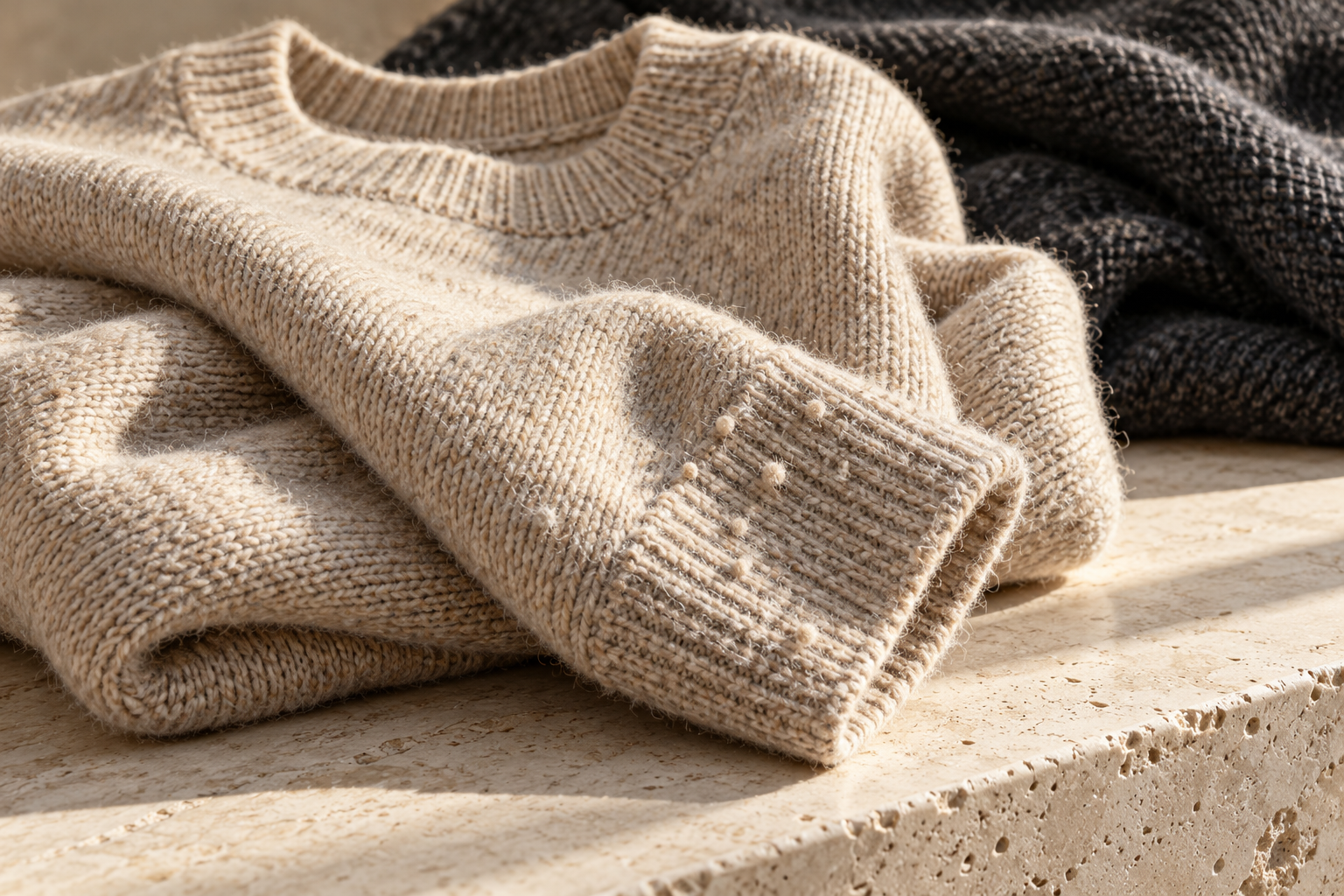
A sweater can feel beautiful on the rail and look tired after repeated wear. The little bobbles on its surface deserve attention, but they are not a complete verdict on the fibre, the price or the life left in the garment.
The useful question for a fashion brand is more precise: will this particular knit keep the appearance promised to the customer, under the care and use it is designed for?
The label is a starting point, not a score
Pilling describes small fuzzy balls that form on a textile surface. Woolmark's care guidance associates them with rubbing during wear, especially where sleeves and the body of a sweater repeatedly meet. It also identifies fibre length, yarn twist and fabric cover as design variables. This is wool-industry guidance, not a controlled comparison of competing sweaters. [1]
Simply substituting one fibre name for another misses the construction question. A fibre-content label cannot describe the entire yarn, knit structure and finish. Nor can a photograph of bobbles establish which material will perform best in a different garment.
Softness and surface stability are different decisions
Cotton Incorporated's yarn reference explains that twist affects both fabric feel and pilling behaviour. Increasing twist can make a yarn firmer and stiffer; lower-twist cotton knitting yarns can produce a softer handle. Its discussion is about yarn engineering, not proof that every soft sweater will pill or that the firmest fabric is best. [2]
The design implication is a tradeoff to evaluate, not a recipe to maximise one variable. A plush lounge knit and a sharp everyday crewneck need not have the same surface. The brief should make that intended character explicit before samples are compared.
A pilling grade needs context
ASTM's Martindale pilling summary describes visual grading from 5, indicating no pilling, to 1, indicating very severe pilling. It identifies fibre dimensions, yarn and fabric construction, finishing, and conditions of use as influences. Results may also depend on whether the sample was assessed as received or after cleaning. [3]
That is not a universal purchasing score. The same summary cautions against using this method for acceptance testing because interlaboratory data are unavailable. A laboratory result should not be turned into a guaranteed number of wears. [3]
ISO 12945-2:2020 describes a modified Martindale method covering pilling, fuzzing and matting. Its public abstract establishes the scope, not interchangeable results with every other method. Naming the equipment alone is therefore insufficient when comparing supplier reports. [4]
Ask for evidence that matches the product
An effective sampling brief can stay short. The following is an editorial recommendation for making evidence comparable, not a new test standard:
- Identify the exact sample. Record the yarn, construction, finish and colourway rather than relying on a generic fibre claim.
- Keep the conditions with the grade. Ask for the named method and edition, exposure or cycle count, preparation, cleaning history and evaluation images.
- Review the whole garment. Combine surface evidence with fit, feel, shape retention and the intended care instructions. A tidy surface is not proof of every other performance property.
- Agree the promise before production. Define the intended appearance and acceptable change for the actual use case; do not invent a universal pass threshold from a single number.
No comparative garment testing is reported here. The conclusion is nevertheless practical: choose the knit for its intended experience, then ask for evidence about the exact fabric. A fibre label tells a composition story; it does not finish the quality conversation.
References
Primary references reviewed October 21, 2026. This is an evergreen materials analysis, not a garment test or a new research announcement. Standards references use public scope summaries, not purchased procedures. Industry guidance is identified separately from laboratory evidence.
- Woolmark: What is pilling?Undated public summary
- Cotton Incorporated / CottonWorks: Textile Yarns, sections 5, 9 and 10January 2010; date printed on page 34
- ASTM International: D4970/D4970M-22(2026): Pilling resistance, Martindale tester; public scope and significanceListing updated July 9, 2026; version of record 2022 method, reaffirmed 2026
- ISO: ISO 12945-2:2020: Surface pilling, fuzzing or matting; public abstractOctober 2020; version of record Second edition