
Fashion has two expensive ways to get a decision wrong: attract attention that never becomes a sale, or buy stock that customers do not want. AI is becoming useful at both ends. It can speed up creative exploration, make products easier to discover and help teams examine demand before committing more money.
But these are different jobs. Generating a campaign image is not forecasting demand. Drafting an answer is not resolving a return. Building a small app is not operating a reliable inventory system. The brands that benefit will be those that connect the right tool to a specific decision.
Design is moving beyond the moodboard.
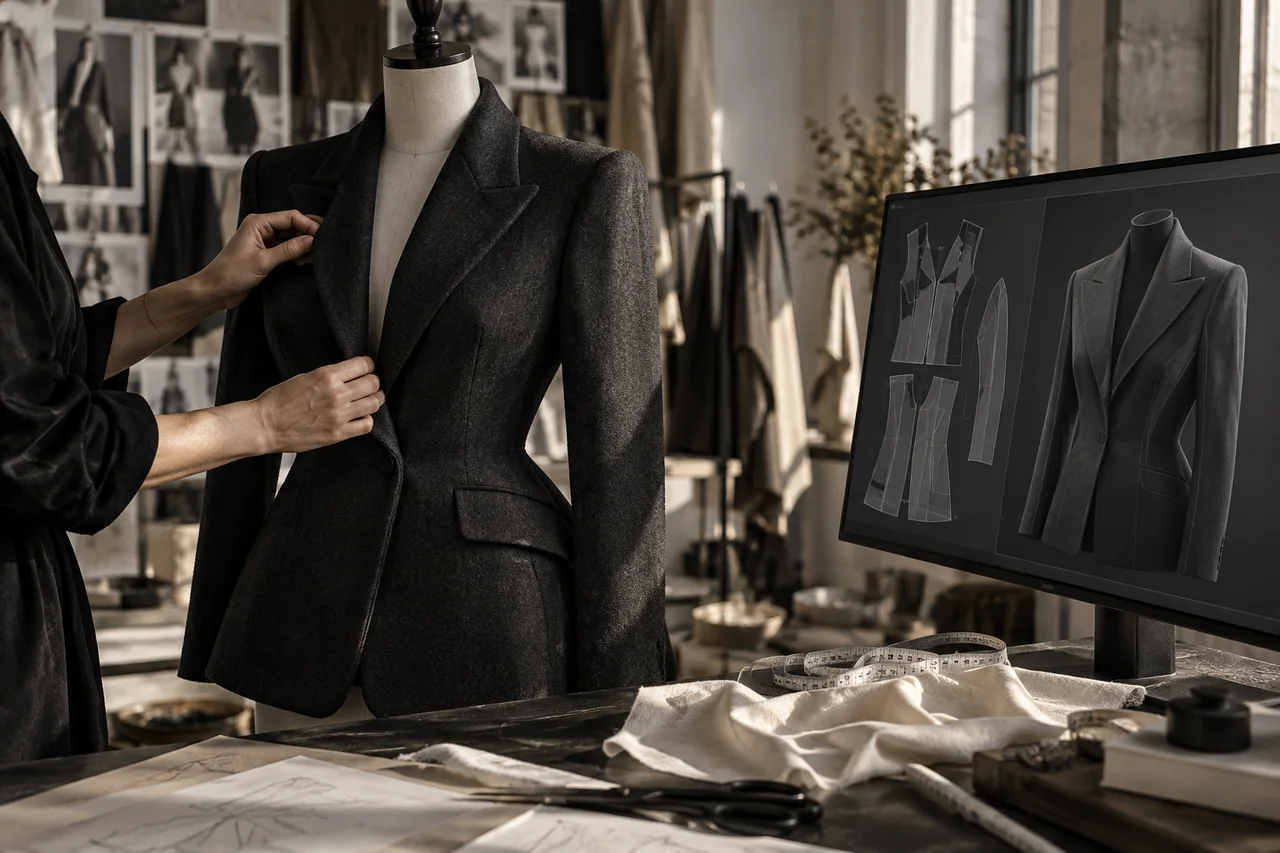
Image generation makes it easier to explore silhouettes, color combinations and styling before a sample exists. The next question is whether those ideas can become garments. EasyFashion, a research preprint revised in October 2026, describes a workflow connecting design intent, body-specific virtual try-on and sewing-pattern generation. Its authors report technical experiments, user studies and a production case.[1]
That is an emerging direction, not evidence that every generated design is ready for a factory. Fabric behavior, grading, construction and physical fit still need checking. The practical opportunity is faster exploration followed by disciplined sampling, not skipping the sample.
Creative speed needs product accuracy.
In August 2026, Zalando described moving AI-supported content production from six-to-eight-week cycles to a few days. The company also explained that it is building automated checks against original product imagery to catch altered colors, construction details and brand marks.[2]
The distinction matters. A setting can change; the garment must remain the garment. An invented pocket or flattering change to a silhouette creates an expectation the delivered item cannot meet. Faster production is valuable when it produces more useful, accurate presentations, not just more variations of the same image.
Discovery is becoming a conversation.
Customers increasingly have ways to describe the look they want rather than search by a precise product name. Visual shopping is changing too: Google's December 2025 expansion brought photo-based apparel try-on to the UK and India.[3] A visual preview can help someone imagine an outfit, but it is not a measurement or a guarantee that a particular size will fit.
For brands, this makes accurate catalog information more valuable. Clear attributes, materials, measurements, availability and images help a product answer a shopper's question. Distinctive styling still earns attention; useful product information helps that attention turn into confidence.
Customer service starts with better information.
Shopify Inbox's suggested replies help staff compose answers, using information already available from the store. Shopify explicitly distinguishes that composing aid from automatic agent responses and instructs staff to check accuracy before sending.[4]
It is a useful model for adoption: shorten the repetitive work without surrendering judgment. Keep product details and policies current. Route unusual delivery problems, disputed charges and sensitive complaints to a person. Measure resolution and repeat contact, not merely the number of generated replies.
The less visible opportunity: buying better.
H&M's September 2026 report links its digital infrastructure work to better precision across product development, purchasing, allocation, marketing and sales. It also describes more in-season purchasing and greater support from AI.[5] The report does not isolate AI's contribution to financial performance; it shows the breadth of the operational ambition.
For a fashion business, the valuable questions are often specific: which sizes sell through, which styles need markdowns, where returns erase margin, and how long replenishment takes. A useful forecast must account for stockouts and promotions, not mistake every past sale for unconstrained demand. Start by comparing recommendations with a simple baseline before allowing them to influence a buy.
Shopify is changing the build-or-buy decision.
Shopify introduced AI-assisted store setup, theme-block generation and expanded Sidekick capabilities in its May 2025 release.[6] Its current documentation goes further: merchants on Grow, Advanced and Plus can generate custom admin apps with Sidekick. Suggested uses include reorder recommendations and small team tools.[7]
This opens a middle ground between spreadsheets and a large software project. A brand can explore a focused tool around its own workflow without rebuilding the storefront. The scope matters: these generated apps operate inside Shopify admin, not as customer-facing checkout or theme applications, and Shopify says to test them thoroughly before installation.[7]
Build the missing workflow, not every system.
A tailored exception queue, stock-risk view or buying worksheet can be a good custom-build candidate. Replacing an inventory system is a different responsibility. Shopify distinguishes on-hand, available, committed, unavailable and incoming quantities; these states are not interchangeable.[8] Its inventory API also warns that absolute updates should come from the designated source of truth and includes safeguards for competing updates.[9]
Our recommendation: keep a dependable commerce and payment foundation, then build the narrow tools it does not provide. Begin with read-only analysis. Test duplicate events, returns, split shipments and recovery before allowing automated writes. Compare the full cost of maintaining that software with the cost of an existing product, including support, monitoring and integrations.
AI can help write code. It does not remove the need to own the outcome when stock, money or a customer's order is wrong.
Choose the decision before the tool.
Start with one bottleneck and one business measure. For creative work, measure time to an accurate approved asset. For customer service, measure resolution. For merchandising, compare stockouts, markdowns and sell-through. For operations, measure exceptions resolved without introducing new errors.
The strongest use of AI is not to make a fashion brand more generic at greater speed. It is to free people to make better creative and commercial choices, while keeping the product, the customer promise and the numbers trustworthy.
Sources
Primary research, company reporting and product documentation reviewed October 15, 2026. Company descriptions are attributed claims, not independent performance tests.
- Qu et al., arXiv preprint v3: EasyFashion: Human-AI Co-Creation and Sewing Pattern Generation2026-10-09
- Zalando: How Zalando approaches AI-powered content2026-08-25
- Google: Virtual Apparel Try On comes to the UK and India2025-12-03
- Shopify Help Center: AI-generated suggested replies in Shopify InboxUndated documentation; accessed October 15, 2026
- H&M Group: Nine-month report 20262026-09-24
- Shopify: Expanding your AI Horizons, Summer 25 Edition2025-05-21
- Shopify Help Center: Generating apps with SidekickUndated documentation; accessed October 15, 2026
- Shopify Help Center: Understanding inventory statesUndated documentation; accessed October 15, 2026
- Shopify developer documentation: inventorySetQuantitiesUndated documentation; accessed October 15, 2026