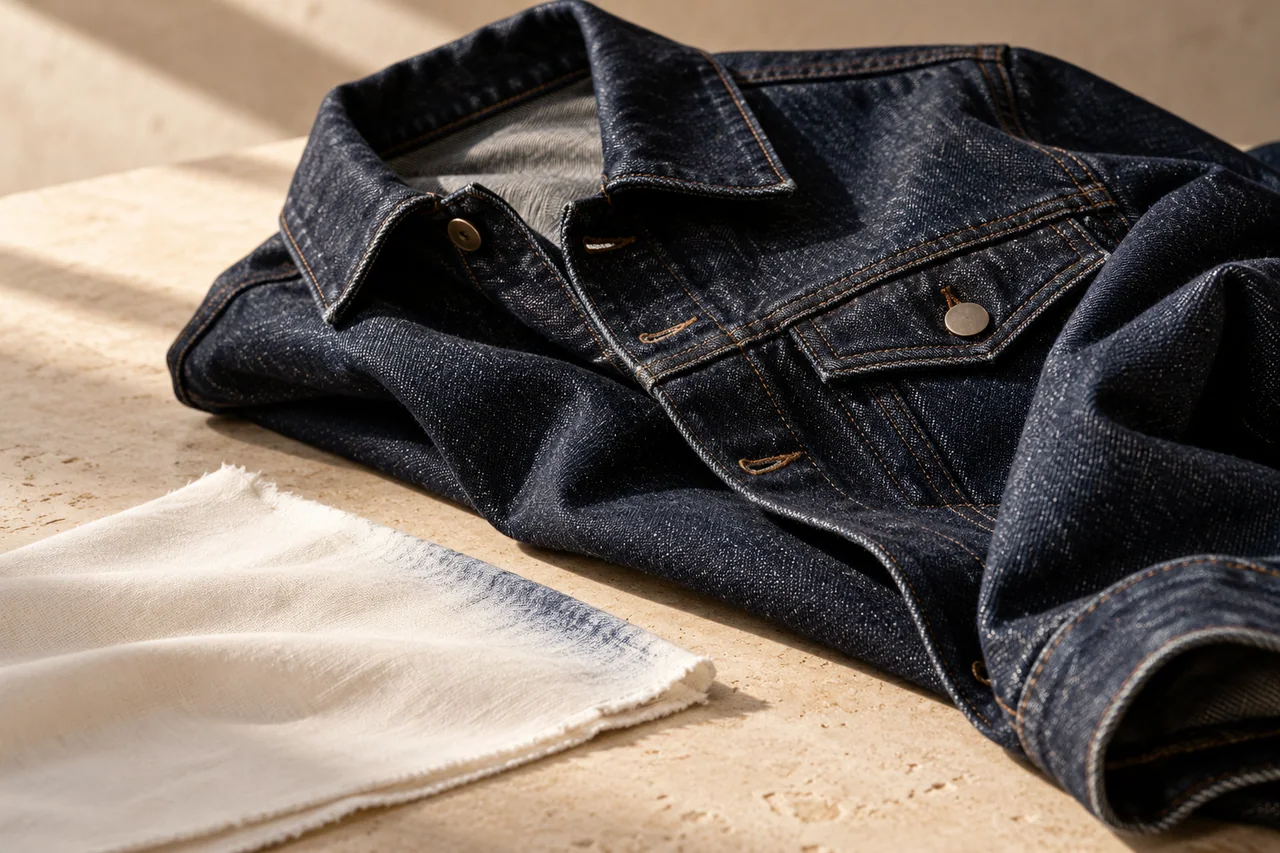
A deep indigo jacket can look better as it ages. Blue marks on a pale bag are a different matter. Both involve color leaving the original surface, but a desirable fade is not evidence that unwanted transfer is acceptable.
For denim development, the useful question is not simply whether a fabric loses color. It is where that color goes, under which conditions, and whether the result matches the way the garment is meant to be worn.
The blue is not distributed evenly
In conventional indigo dyeing, color concentrates toward the outside of the cotton yarn rather than penetrating evenly through its cross-section. A lighter core remains. Repeated dye applications and oxidation build the shade at the surface. This ring-dyed structure helps explain the contrast associated with worn indigo denim. It does not describe every colored denim construction. [1]
The process matters as much as the shade. CottonWorks describes rinsing to remove unfixed surface deposits and warns that excessive drying can move more dye toward the surface, increasing the tendency to transfer by rubbing. Two fabrics that look similarly dark therefore should not be treated as having identical transfer behavior. The latter is a reason to request evidence, not a claim that either fabric has been tested here. [1]
Fading, bleeding and crocking answer different questions
Crocking means color transfer caused principally by rubbing. Bleeding describes colorant entering a liquid medium. AATCC's terminology separates these mechanisms within the broader subject of colorfastness. A garment becoming lighter, a wash bath becoming blue and an adjacent surface picking up a mark are not interchangeable observations. [3]
That distinction changes the product conversation. A description such as “develops a personal fade” explains an intended appearance. It does not, by itself, answer a customer's concern about contact with a light-colored accessory.
A rubbing test needs its conditions attached
AATCC TM8 assesses transfer from a colored textile to a white test cloth under controlled rubbing. Its public summary specifies both dry and water-wetted cloth procedures; staining is compared with an evaluation scale and assigned a grade. It also notes that laundering, finishing and other treatments can change the result. [2]
The useful report therefore identifies the method, dry or wet condition, treatment history and resulting grade. “Colorfastness tested” without those details leaves the actual question unresolved. A dry result should not be silently substituted for a wet one, nor an untreated fabric result for a finished garment result. This is an evidence checklist, not a reproduction of the full method or a pass threshold. [2]
Make the promise match the garment
For a fashion team, the practical decision is to separate three things: the intended visual aging, the documented transfer performance and the care or contact guidance supplied with the product. Review the exact finish and colorway being offered, rather than treating a general story about indigo as a specification.
No comparison test is reported here, and these references do not establish that a particular brand, price point or wash is better. The editorial recommendation is narrower: retain the character of denim while making its limits understandable. A beautiful fade is a design story. Color-transfer performance needs its own evidence.
References
Primary references reviewed October 20, 2026. This is a materials explainer, not a newly announced development or an independent denim test. The TM8 reference is its publicly available scope and principle, not the purchased procedure.
- Cotton Incorporated / CottonWorks: Denim Construction: Dyeing and Warp/Ball Warp DyeingUndated public summary
- AATCC: TM8-2016e(2022)e: Colorfastness to Crocking, CrockmeterUndated public summary; version of record 2016; editorial revision and reaffirmation indicated in the 2022 designation
- AATCC: M11-2021: Glossary of AATCC Standard Terminology, p. 5132021; reproduced in the 2022 manual